
Disclaimer: This name is a fiction of mine. To my knowledge, there is no reference to this name in the literature. But that is not important.
During my journey as a coach, I have learned and acquired knowledge by observing many, many games from different countries, competitive contexts, different ages, etc.
And I continue to do so because the pleasure of the game is indeed in observing and learning.
Playing from the back with 2, 3, 4, or 5 players, including or not including the goalkeeper, full-backs inside or outside, wingers inside or outside, defining pressing zones, waiting for the opponent and counter-attacking – everything is valid.
“As long as the players understand it,” as Pep Guardiola once said.
But one of the things that made me feel I added value to my teams was instilling the need for constant movements to disrupt the opponent’s defensive structure.
Specifically, the defensive line.
Destabilizing, moving, questioning, and creating doubt about who should do what are the foundations of this need.
Any defender would agree that having a more static opponent is certainly more stable than the instability that movement naturally causes. Despite having fabulous players who can play with their body, physically powerful and capable of holding off a defender and protecting the ball, or those capable of receiving the ball always in the same zone and manner and still causing imbalances.
Nevertheless, probabilistically, there should be no doubt about the structure capable of causing more damage, and movement clearly wins!
It is from this need for movement and seeking spaces to exploit that the Theory of Opposite Movements is born.
The theory defines, at its core, that players relate to each other in a synchronized, organized, but simultaneously unstable and unpredictable manner, moving in a way that is inherently opposite to their previous one.
For example, if the player wide has the ball, the nearest and most advanced player has the responsibility to:
- Find the most suitable space to receive the ball in favourable conditions to continue the play, bringing the team closer to scoring
- Make an approach or breaking movement
- Outline the movement of all subsequent players (even if unconsciously!)
What is the problem with this theory?
There are a few, without a doubt.
The first is simple: it’s not for all players!
Not everyone can understand it!
Secondly, for those who (like me) think they can implement it, even if there are initial difficulties in understanding the concept: it takes a long time to be effectively implemented. I’m talking about months, potentially!
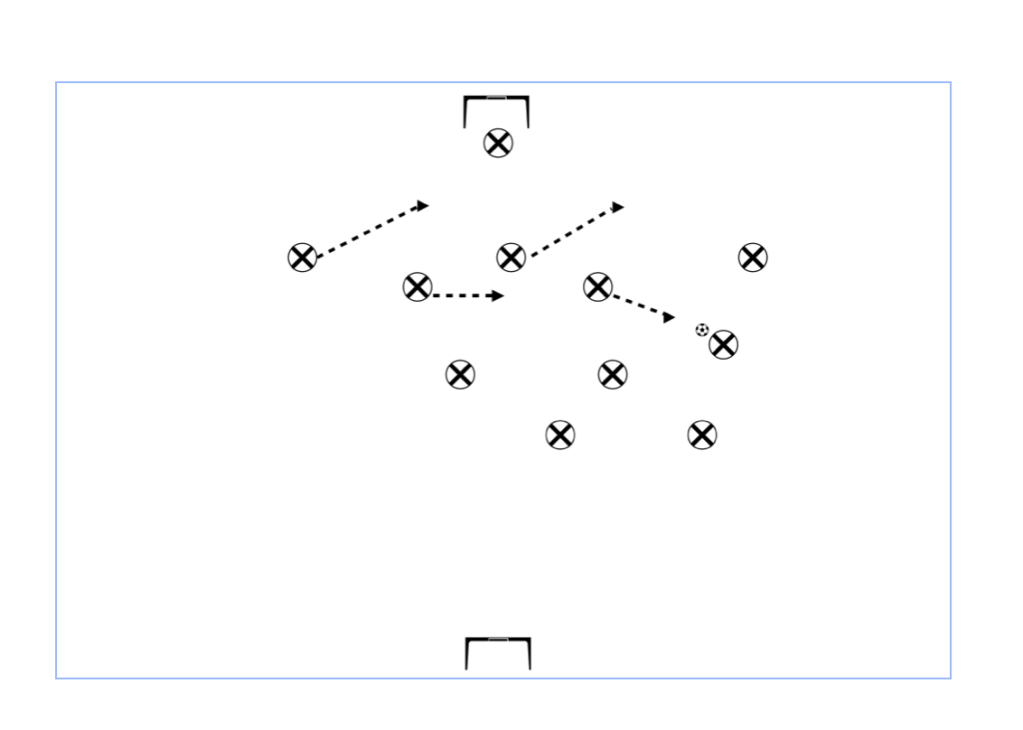
Of course, it always depends on the level we work at, but it ALWAYS takes longer than the classic synchronized movement between 2-3 players, like the overlaps of the full-backs or the approach and breaking movements when playing with 2 forwards, for example. These, without questioning their effectiveness and efficiency, are simpler in their genesis because they are less complex and involve interaction between a smaller number of players.
Other problems may also exist, such as the fatigue it causes, the length of each movement, or the collective consistency and preparation for defensive transition.
This is my perspective, a way of seeing the game. One that feeds my need to be unpredictable while maintaining an organized structure of expected movements. One where neither I nor the players (ours and the opponents) know what will happen next, but I know that everyone will interpret it the same way.
This is the success of my work – to provide everyone with clear Principles and Specific Behaviours for any and every Game situation, which are expected and interpreted by everyone in a similar manner, but depend on the situation and the players’ decision-making.
Because they are the ones who play.
And that, to me, has immeasurable power.
The power to influence decision-making.
It’s not exclusively mine, nor could it be.
What do you think of this Theory?
Is there anything you would like to add?
Let’s analyse the Game!


 TacticTalks
Deixe um comentário